

Anthropic’s IPO filing uses the word “compute” more than 500 times. That’s more than references to “revenue” or “safety”.
On Monday, Anthropic made its S-1 public. That’s the giant document a company files with the SEC before it can sell shares on the stock market. It plans to list on Nasdaq under the ticker ANT, and reports say the IPO could raise around $100 billion, which would make it the biggest ever.
Note that some final numbers, like share price, aren’t in the filing yet. That will come later in an updated filing ahead of the IPO.
1. The growth is real, and it’s getting more efficient to deliver
Anthropic’s revenue went from $1.2 billion to $16.3 billion, comparing the first half of 2025 to the first half of 2026. That’s about 14x in a year. For context, it made $4.6 billion in all of 2025.
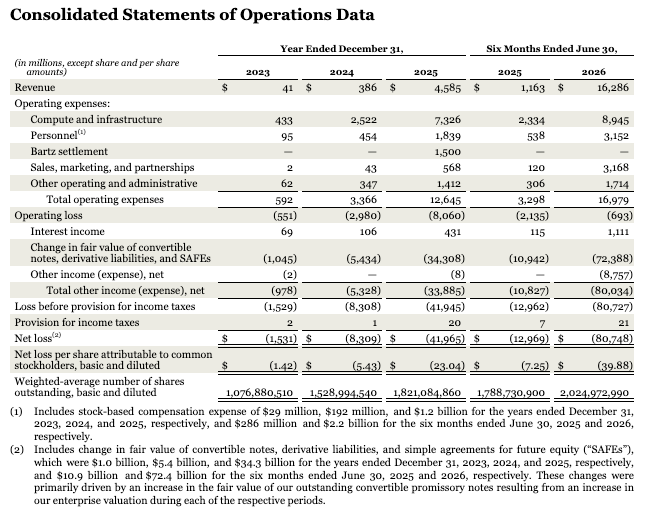
The more interesting number is what happened to its biggest cost. Over the same period, spending on computing power (the chips and cloud capacity that train and run Claude) went up only about 4x, from $2.3 billion to $8.9 billion.
In plain terms: revenue is growing much faster than the cost of the thing it sells. However, because Anthropic books much of its computing capacity in advance, this means some hefty upfront spending commitments, especially when it comes to the current demand landscape for compute power.
It also says each new model makes the work cheaper for customers. Its latest model, Opus 5.5, cut customers’ cost per task by about 40%. When the work gets cheaper, people use more of it.
One caveat: Anthropic has already signed up for far more computing power than it uses today (more on that below). The revenue growth outpacing the cost of compute growth story only holds if revenue keeps outrunning that bill.
2. It’s less dependent on a few big customers than previously reported
Earlier this year, reports based on a draft of the filing said about 20% of Anthropic’s revenue came from just two customers.
However, the latest public filing paints a broader picture:
No single customer made up more than 10% of revenue in the first nine months of 2026.
About 79% of Q3 2026 revenue came from customers outside its top five, up from about 64% in Q1 2026.
Customers spending $100,000+ a year grew from more than 950 at the end of September 2025 to more than 11,900 by end of September 2026. Over half the Fortune 500 is in that group.
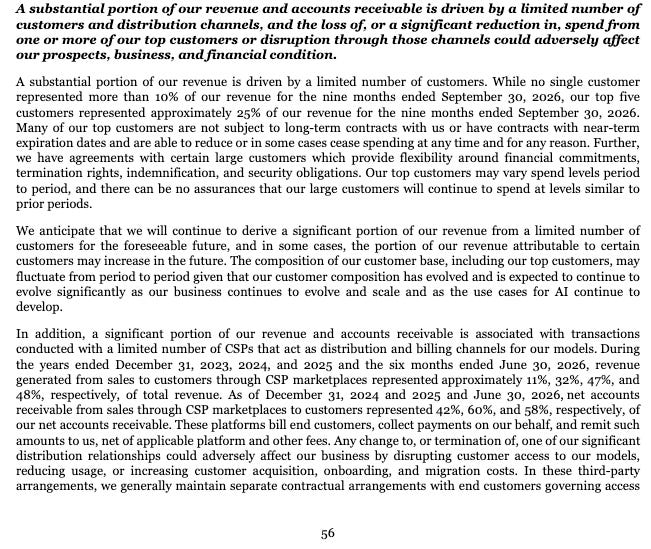
The filing still lists customer concentration as a risk, and its biggest customers are growing too: each of its top five hit a record high last quarter. But “two customers are a fifth of the business” doesn’t appear to be the story anymore.
3. Every layer of The AI Village I previously illustrated shows up as a documented risk factor
Now, I won’t pretend to have read a ton of S-1’s. But many times throughout this document I found myself thinking “didn’t I just read this section?” Part of that was the structure of the S-1, but part of it was just how often compute was cited as a potential risk factor to the business.
In my AI Village post, I mapped the AI industry as a village with layers: apps on top, then models, then cloud and compute, then chips, then data centers and power at the foundation. Anthropic sits in the model layer. Its filing reads like a tour of every layer below it, and each one shows up as a risk.
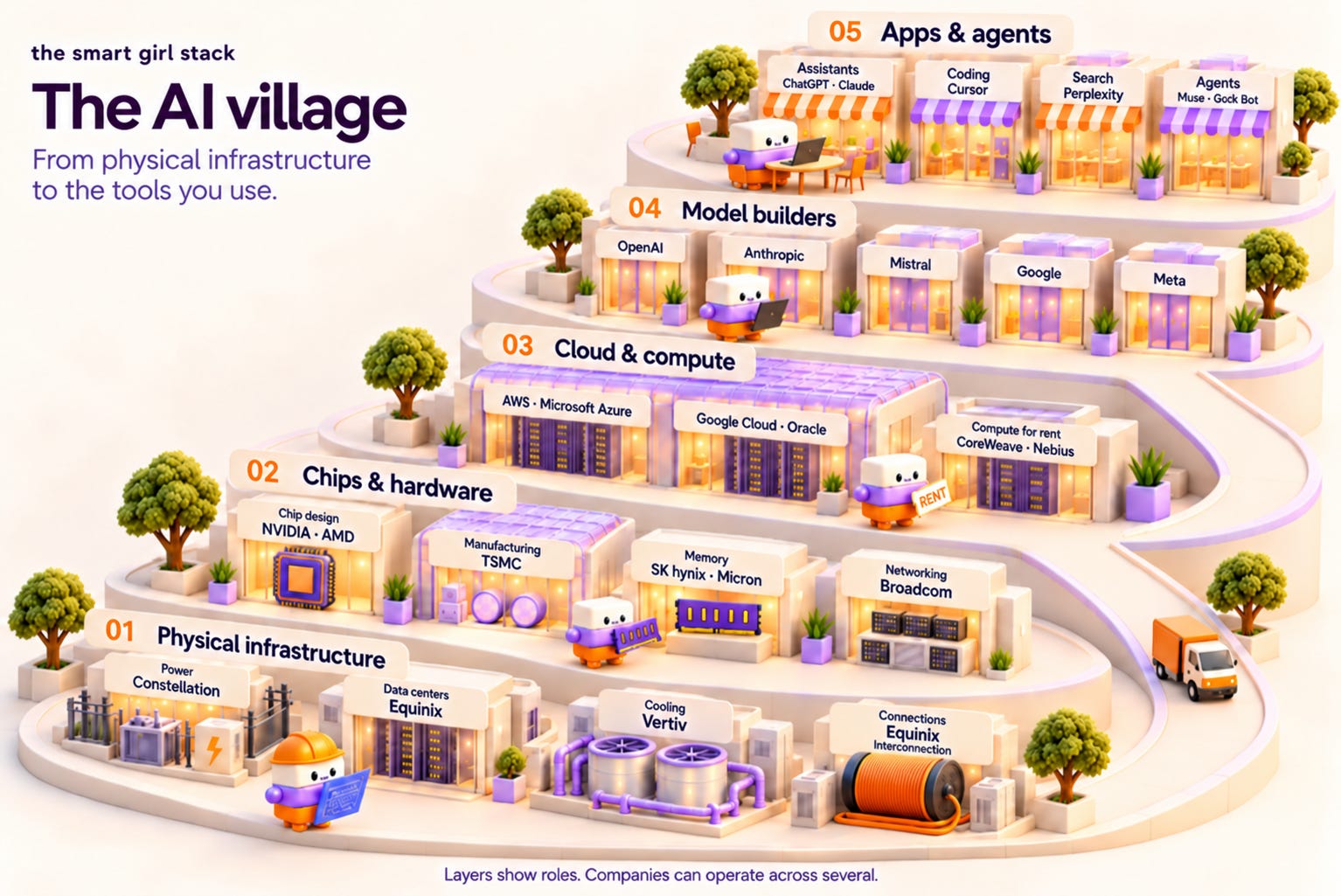
The cloud: landlords who are also competitors
Anthropic rents much of its computing power from Amazon, Google and Microsoft. In its own words, these companies “simultaneously serve as our investors, customers, distribution partners, and competitors.”
In the Village post I pointed out that Google’s Gemini competes with Claude while Google sells Anthropic computing power. The filing confirms it and goes further. Google is also an investor as well as a customer. Nearly half of Anthropic’s revenue (48% in the first half of 2026) comes in through Amazon’s, Google’s and Microsoft’s cloud stores, where companies buy Claude on their regular cloud bill.
The catch is who gets the computing power when there isn’t enough to go around. The filing says its ability to get compute “is subject to allocation decisions by our CSPs” (cloud providers), and admits: “we have in the past sought quantities of compute from CSPs in excess of what those partners were willing to provide.”
Chips and memory: a handful of makers
The filing names the companies the whole industry depends on. TSMC makes most of the world’s most advanced chips, and SK hynix, Samsung and Micron make most of the specialized memory AI chips need. It says TSMC has “at times, been unable to fully satisfy market demand,” and as a result Anthropic has “not always been able to obtain sufficient quantities of chips on a timely basis.”
Data centers: building its own
Power: the foundation
These data centers need enormous amounts of electricity, and power is often the hardest part to secure. Anthropic doesn’t generally build power plants itself. Instead, it signs long-term deals with utilities for dedicated power, or agrees to arrangements where power is built for its facilities. Either way, it commits years ahead, and for years at a time, before it knows exactly how much demand there will be.
That timing is part of the risk. Power deals take years to put in place and to bring online, and the filing also notes that local opposition to data centers “has also become more organized and coordinated,” which can slow or block a project even after the money is committed.
The common thread: booking years in advance
Across every layer, suppliers want commitments up front. So Anthropic has to predict how much computing power it’ll need years from now and sign deals in advance, “often with limited ability to adjust commitments if our needs change.”
Those compute forecasts are inherently uncertain. The filing points to research pace, how compute-intensive training new models is, customer demand, and how fast hardware gets more efficient.
Anthropic admits that “In the past, we have significantly underestimated our compute requirements, which left us capacity constrained.”
The filing lists individual deals like at least $110 billion with Amazon, about $114.5 billion with Google and $44.9 billion with Microsoft, many payable “regardless of actual usage.” It leaves the grand total blank for now. The Wall Street Journal says the infrastructure costs could rise to $750 billion based on disclosed deals that include chip leases.
4. If you buy the stock, you technically get a vote, but you don’t get a say
Anthropic’s setup is unusual even by tech-company standards:
The seven co-founders will share a single special share that carries 50.1% of the votes on regular shareholder matters. Whatever they vote for wins.
An independent trust of five people with backgrounds in AI safety, national security and public policy picks a majority of the board. Its trustees have no financial stake in the company, and they don’t run it day to day. Their power is choosing directors.
Public shareholders get one vote per share, but they can’t outvote the founders, and they don’t vote on the trust’s board seats
Big investors like Amazon and Google mostly hold non-voting shares.
The filing is upfront about the trade-off. The structure “may effectively eliminate the ability of holders of our Class A common stock to influence important decisions, including a change in control.” In practice, nobody can buy Anthropic unless the trust and founders agree.
Why build it this way? Anthropic is a “public benefit corporation” whose stated purpose is “the responsible development and maintenance of advanced AI for the long-term benefit of humanity.” The structure is meant to protect that mission from short-term pressure from shareholders.
There’s also a philanthropic piece: 5% of the company’s shares went to a fund for public-benefit work, and each co-founder pledged to give away 80% of their personal stake.
The short version: buying Anthropic stock means you’d be buying a piece of the business, not a say in how it’s run.
5. Overall velocity, and Claude Cowork Adoption
I feel like Claude Code gets a lot of buzz as a hugely popular coding tool. Admittedly, I was an early Claude Code adopter and have spent a lot more time there than in Claude Cowork. So I was a bit surprised to see the initial adoption numbers of Cowork outpacing those of Claude Code: the filing states that it “outpaced the adoption Claude Code achieved at the equivalent point” after launch.
The pace at which Anthropic releases also seems pretty unparalleled as far as I’m aware. They’ve done 250 launches in nine months. That can mean new models, features, or apps. And that equates to more than one every business day.
6. Not a ton of focus on open-weight model competitors
One risk I thought the filing underplayed, and this part is my own speculation, is the potential risk of cheaper open-weight models eating into Claude’s model business.
Open-weight means the model’s weights (the numbers that make it work) are published, so anyone can download and run them, often much more cheaply. That doesn’t mean everything about the model is public, and it doesn’t mean they’re all from one place. DeepSeek is the best-known example right now, but the category also includes models from Meta, Mistral, and others.
Across more than 90 pages of risk factors, the S-1 gives that specific pricing pressure essentially one sentence, plus a note elsewhere that open models compete for work that prioritizes cost efficiency over intelligence.
Developer platforms like OpenRouter and Vercel AI Gateway do show a good portion of their routed traffic going to open-weight models. But those charts are not representative of the full market picture here: they only measure tokens routed through those platforms, not revenue across the whole market. Anthropic’s enterprise traffic mostly wouldn’t show up there, and Anthropic’s own numbers show those big customers continue to increase their spend on Claude as of end of Q3 2026.
So I’m not calling this an immediate threat. It’s simply a data point I’m keeping an eye on in the long-term.
7. Chip stocks had a rough few weeks, then bounced on filing day
After a rough couple of weeks, the semiconductor ETF SOXX closed up almost 3% on Monday, October 26. Chip stocks like Nvidia, Micron, Broadcom, and AMD also closed up ~2 - 3%.
I’m curious to see how the rest of the AI industry stocks react to Anthropic’s IPO. If Anthropic prices well in November, does it lift the whole sector?
The big picture
First, congratulations to everyone at Anthropic!
So what does this filing actually tell us? For now, revenue is growing much faster than the cost of compute, but Anthropic is locking in that compute years ahead, before it knows what demand will look like. Possible future constraints on compute, chips, and power are real risk factors to the business. And it’s a real-life example of how competitors can also be your investors and your customers in the AI industry.
Disclaimer: This post is for education only, not investment advice. I’m not a financial advisor, and nothing here is a recommendation to buy or sell any stock.