

I work in AI, and I still keep a running list of company names I hadn’t heard of six months ago. Nebius. Cerebras. Lambda. I feel like every week, another one shows up attached to a deal worth billions.
I wanted an easier way to see, at a glance, what each of these companies actually does, how they fit together, and why they keep doing deals with each other. Mostly so I could form my own opinion about their businesses instead of nodding along to headlines.
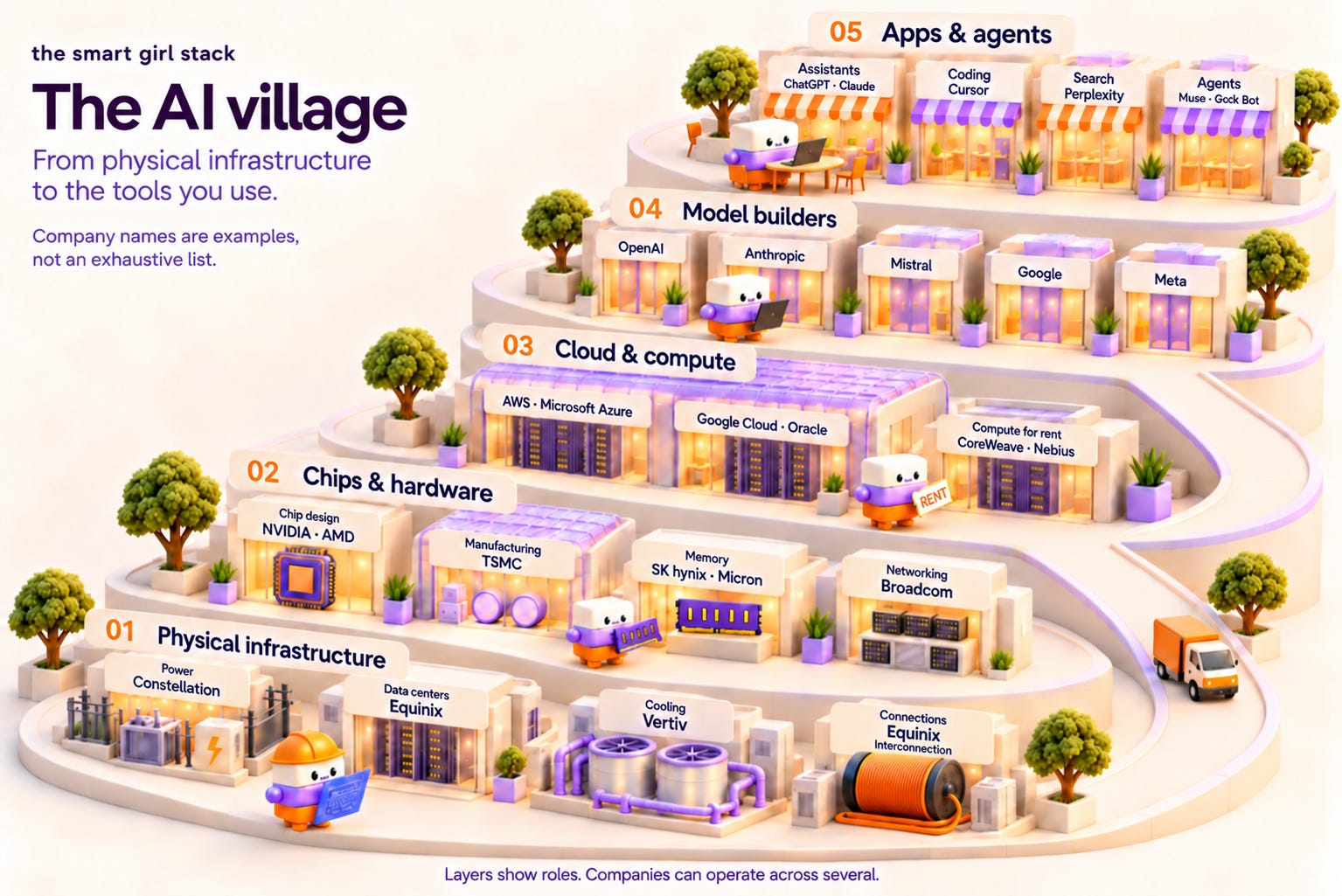
So I had ChatGPT help me draw one. Welcome to The AI Village 🏡 🤖.
Why this matters (even if you don’t care about AI)
The headlines are full of NVIDIA, OpenAI, Microsoft, Meta, and enormous deals between companies you thought were competitors. It’s hard to tell who makes what, who needs whom, or what any of it has to do with the app on your phone.
If you’re thinking, “Cool, but I mostly use ChatGPT for recipes,” here’s the twist: your money may be more involved than you are. By one JPMorgan analysis, 41 AI-linked companies made up about 49% of the S&P 500’s value as of early October 2026.
So, if you have a 401(k) or an index fund that tracks the S&P 500, you’re probably already more involved with AI than you realized.
One request, five layers
Let’s follow one ordinary request through the village:
Help me plan a weekend in Chicago. Find a cute hotel under $250 a night, near restaurants and an art museum, and suggest an itinerary.
Somewhere between “cute hotel” and “please keep it under $250 a night”, you’ve tapped into model builders, chip designers, cloud providers, and power companies. You weren’t thinking about any of them. You just wanted a hotel.
We’ll start at the top of the village, with the app you actually use, and work down to the foundations.
One thing the map can’t show: this isn’t a relay race where your message climbs down five floors and back. Every request leans on all five layers at once. The app runs on a model, the model runs in the cloud, the cloud runs on chips, and the chips need a building with power and cooling. Each terrace shows what that layer needs from the one below it. And some companies (e.g., Google) own property in more than one neighborhood.
Apps & agents: the storefronts
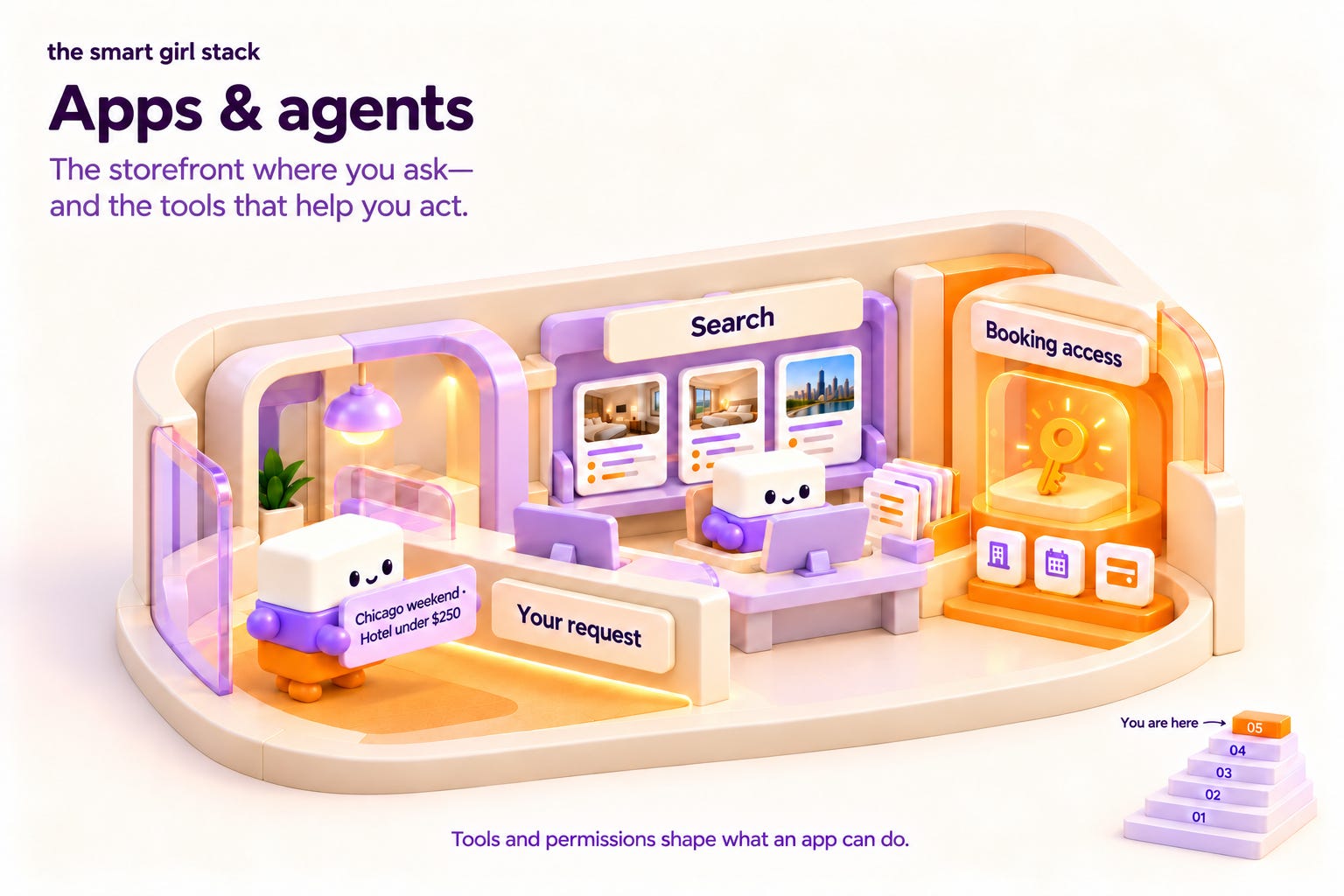
ChatGPT, Claude, or your AI assistant of choice is the front door. The app is where you type, upload a file, read a response, and use whatever tools it offers.
Like a travel agency’s storefront, it bundles several capabilities into one experience. You don’t need to know which system handles each step to ask for a travel itinerary.
Many AI assistants and agents can also take action for you, from running a search to filling out a form, depending on the tools and permissions they’ve been given. For our Chicago trip, that could mean handling the hotel search and comparison, and, with your permission, the booking.
The storefront and the model behind it sometimes come from different companies. Take Cursor, an AI coding app: you can work inside Cursor while using a model built by Anthropic. Cursor supplies the workspace and tools; Anthropic supplies the model. In village terms, that’s a shop in the apps neighborhood paying the model-builders neighborhood every time you use their model.
Examples of who lives here: assistants like ChatGPT, Gemini, and Claude; Cursor for coding; Perplexity for search; and a fast-growing crowd of agents like Meta’s Muse.
Model builders turn your request into a response
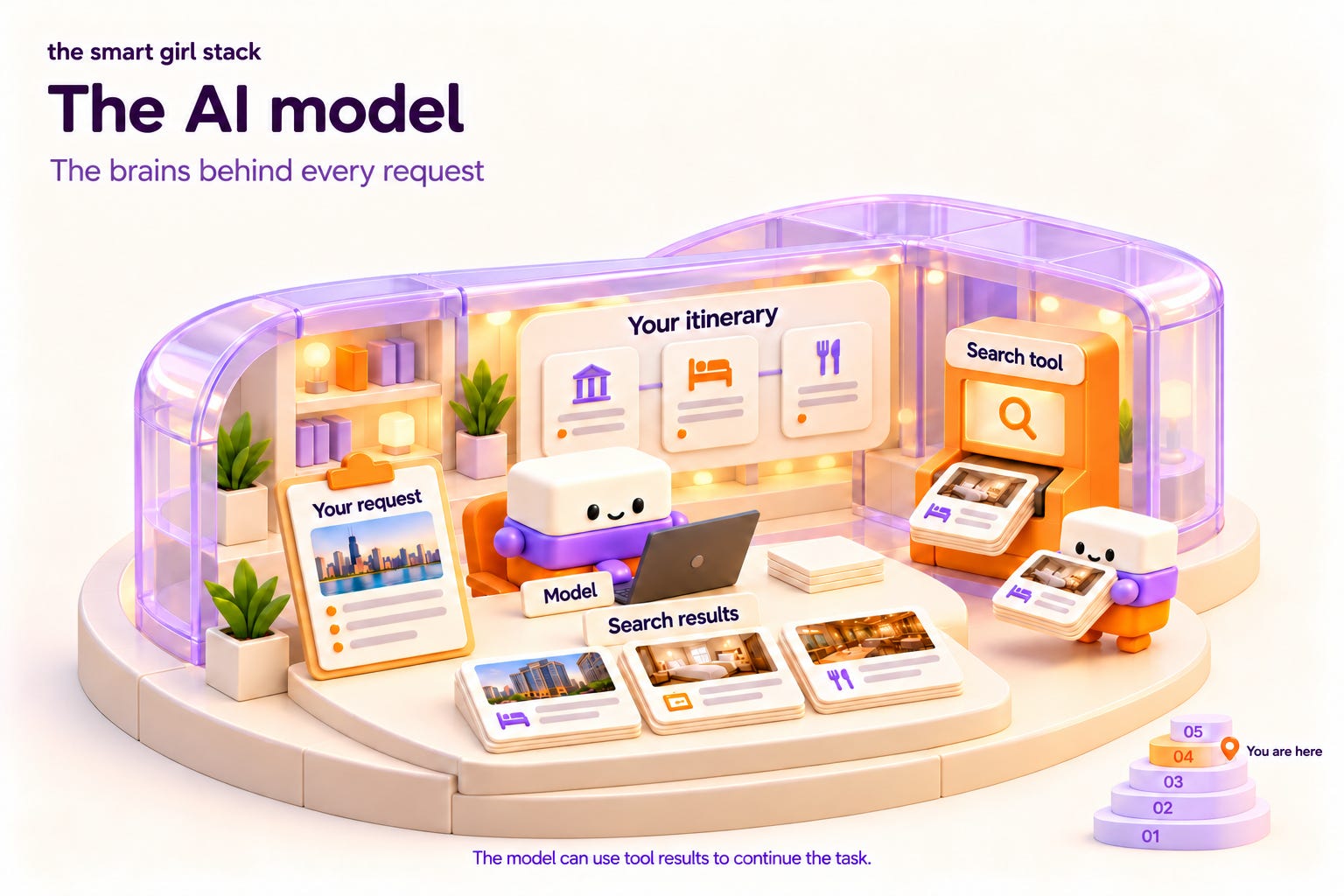
Behind the storefront is the model: the system that reads your request and writes the response. Think of it as the itinerary planner at the desk. For our trip, it’s juggling your budget, location, dates, and the kind of weekend you want.
A model’s own knowledge is frozen at the point it was trained, so it doesn’t carry live hotel prices in its head. It can look them up with tools like web search, but it can still slip up and search the wrong thing, misread a source, or answer from memory when it should have checked for more current information.
When it does search, the handoff goes roughly like this: the model asks for a search, the app runs it, the results come back, and the model picks up from there, sometimes over several rounds. (Simplified, but that’s the shape of it.)
Two terms will come up in this series:
Training is how a model learns its capabilities in the first place. It happens before you ever get to use the model, and it’s an enormously expensive and compute-intensive process.
Inference is the model using what it learned in training to answer a new request. Your Chicago request is inference, and every request like it draws computing power from the layers below: the cloud, the chips, and the buildings that house them.
You’ll also see model names that sound like code names: Claude Opus 5.5, GPT-6.1 Sol, Muse Spark, etc. Most are a family name plus a version number. The family usually signals the tier (most capable, balanced, or fast and cheap), and the number marks the generation. Your apps usually pick a default model for you, so you don’t need to track these, unless you’re building software, where the choice can matter a lot.
Examples of who lives here: OpenAI, Anthropic, Google, Meta, Mistral, etc.
Cloud & compute: the rented workspace
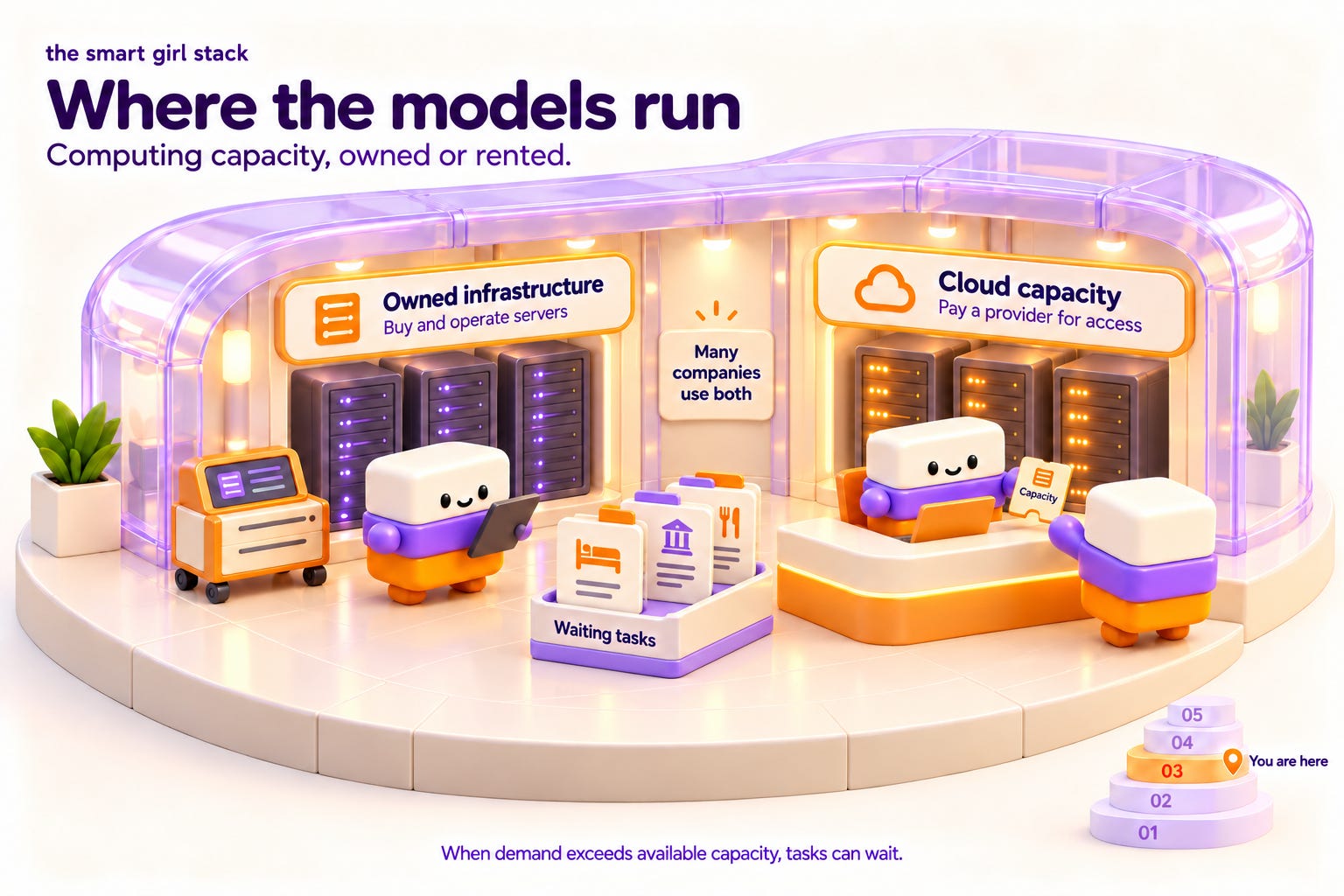
The model needs computers to run on: rows of servers packed with processors, memory, and storage, linked by high-speed networking and housed in data centers. “Compute” is the industry’s shorthand for all that capacity.
Cloud providers rent that capacity out. It’s like renting a fully equipped office instead of building and running your own building. In practice, AI companies mix and match: they buy some servers, rent some capacity, and lock in more through long-term contracts.
That capacity isn’t infinite. When demand spikes past what’s available, requests queue up and responses slow down, which is one reason providers set usage limits or sell different levels of access. (Not every limit means the system is maxed out. Usage limits are also product and pricing decisions.) For your Chicago trip, this is the rented desk space where your request actually gets worked on.
Examples of who lives here: the big clouds (AWS, Microsoft Azure, Google Cloud, and Oracle), plus specialists that rent out AI computing power, like CoreWeave, Nebius, and Lambda.
So what’s actually inside that workspace? The next two layers: the chips doing the work, and the buildings, power, and cooling that keep them running.
Chips & hardware: the machines doing the work
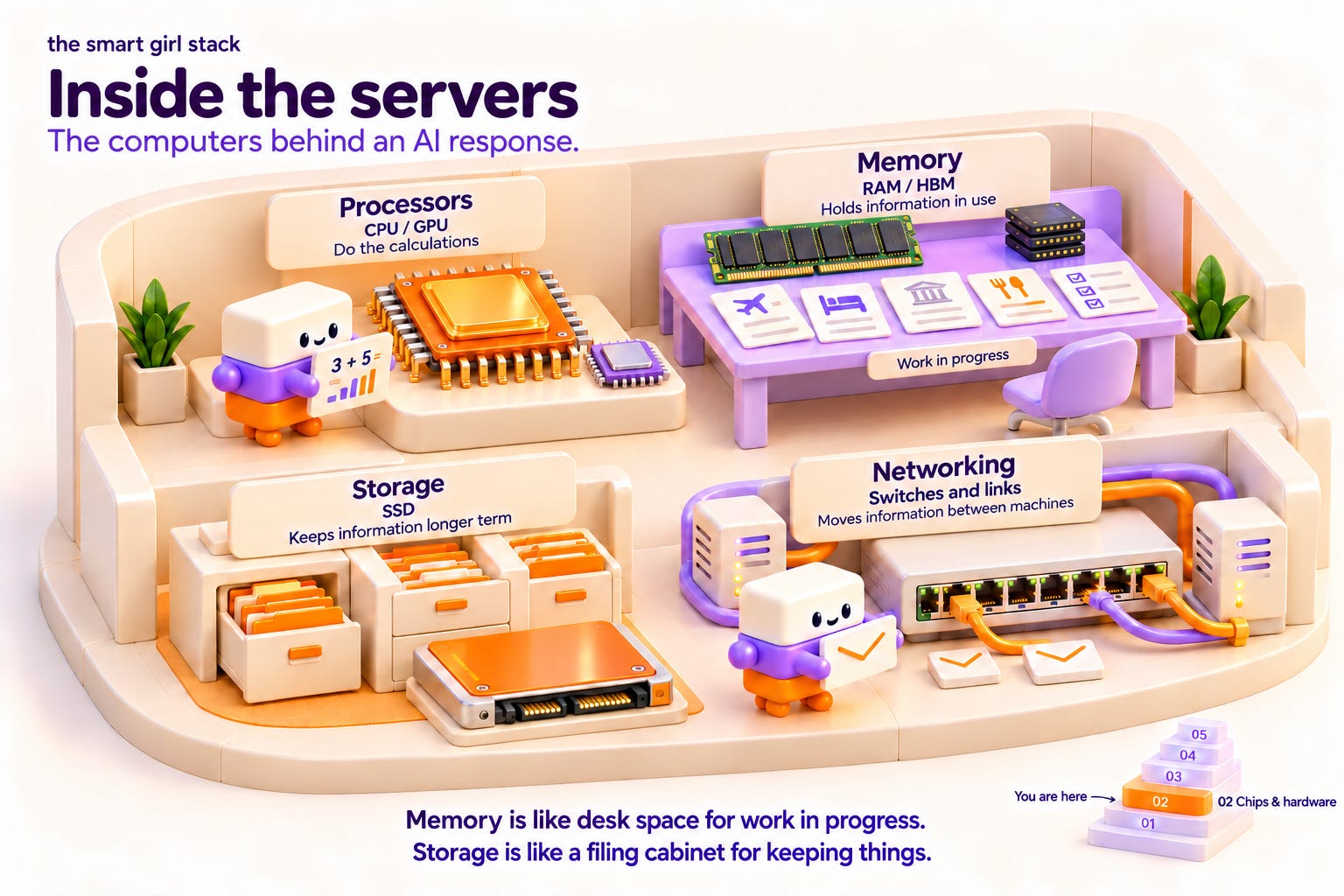
When we say “computers,” picture rows of powerful machines in tall cabinets called servers. They have the same basic parts as your laptop, just configured (and multiplied) to run AI:
A processor does the calculations.
Memory keeps information it’s working on close at hand.
Storage holds information longer term.
Networking moves it between machines.
Think of a desk: the processor is you doing the work, memory is your desktop, storage is the filing cabinet, and networking connects you to the other desks. A bigger filing cabinet won’t fix a crowded desktop.
You’ve probably heard about NVIDIA’s GPUs: processors that are good at running many calculations at once, which makes them useful for AI. AMD makes competing GPUs, and Cerebras takes a different approach, building one giant chip instead of many small ones. But the hardware story goes well beyond processors. Memory comes from SK hynix Samsung, and Micron. TSMC manufactures many of the chips other companies design. And companies like Broadcom supply the networking.
Most companies specialize in one or two of these, and switching specialties takes years and billions of dollars. Some of the big players keep expanding into their neighbors’ territory: Google, Amazon, and Meta all design their own AI chips, and OpenAI recently unveiled its first, Jalapeño, built with Broadcom.
Examples of who lives here:
Chip design: NVIDIA, AMD, Cerebras, and Broadcom
Manufacturing: TSMC and Samsung
Memory: SK hynix, Samsung, and Micron
Networking: Broadcom and NVIDIA
Physical infrastructure keeps the village running
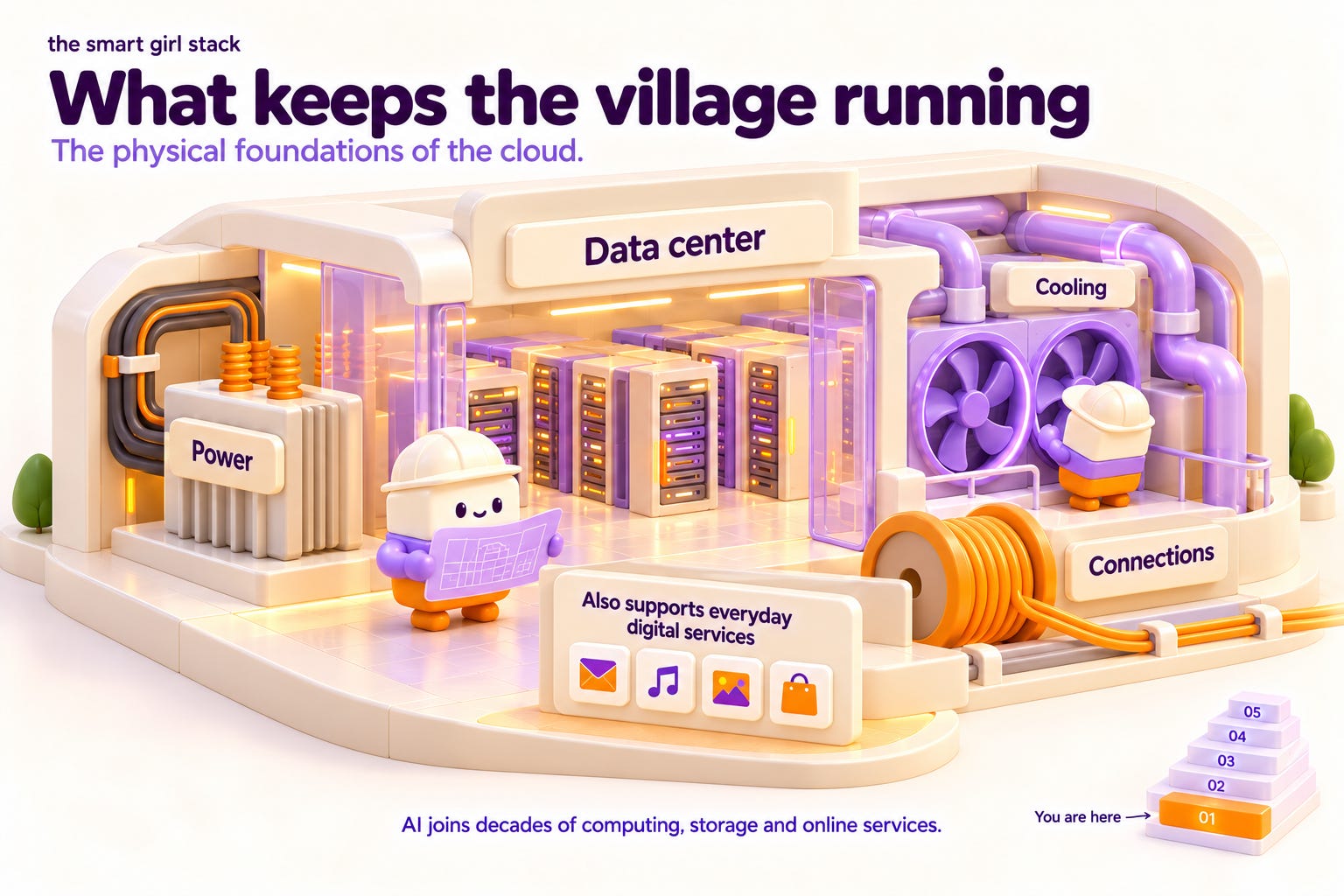
All those machines have to live somewhere, and that somewhere is a data center: a building, or a campus of buildings, filled with rows of servers. A data center supplies what those machines can’t run without: reliable electricity, cooling to keep them from overheating, and two kinds of connections. One goes to the power grid. The other goes to the fiber-optic cables that carry your request over the internet and send the answer back to the app on your phone or computer.
Some data centers are built and run by the big cloud companies themselves. Others belong to operators that rent out space, power, and cooling to many customers at once, a bit like a landlord for servers.
Data centers aren’t new. Their roots go back to dedicated computer rooms in the 1940s, and the modern versions of them have quietly handled much of your digital life for decades: websites, email, online shopping, streaming, social media, video calls, and the cloud backup holding your camera roll. Data centers already sit behind most of your digital life.
What’s new is how fast AI is adding to the load. According to the International Energy Agency, data centers’ electricity use worldwide grew 17% in 2025. At AI-focused data centers, it grew 50%. The IEA expects total data center electricity use to roughly double by 2030. (Those figures measure electricity, not new buildings.)
Examples of who lives here:
Data center operators: Equinix
Cooling and power-equipment makers: Vertiv
Power companies: Constellation
Why the same companies keep making deals with each other
Now the headlines get easier to read. When two AI companies announce a deal, one of four things is usually changing hands:
Equipment: the machines and components that do the work.
Compute: access to someone else’s computing capacity.
Model access: the right to use a model inside a product.
Equity: an ownership stake in the other company.
For example, CoreWeave has an agreement to supply AI infrastructure to OpenAI, while also becoming an investor. OpenAI is the customer, buying computing capacity, and it also took a stake in Coreweave. Amazon’s relationship with Anthropic is similar: an investment plus Anthropic’s use of AWS infrastructure.
Companies can also compete in one neighborhood while doing business in another. Google, for example, builds Gemini, which competes directly with Anthropic’s Claude model. Google has also invested in Anthropic and sells it compute capacity. That’s why the village labels describe roles, rather than assigning every company one permanent address.
When the next deal appears in your feed, ask:
What’s changing hands: equipment, compute, model access, or ownership?
What does that let the buyer do that they couldn’t before?
Next up: a deep dive into data centers
Your Chicago itinerary is the visible tip of all this activity. Behind it are software decisions, rented capacity, specialized machines, and a lot of electricity. Once you can see the layers, you can make sense of both the tool in front of you and the industry behind it.
Next up in this series, we’ll start at the bottom of the village: data centers, and the power and cooling that keep them running.
Disclaimer: This post is for education only, not investment advice. I’m not a financial advisor, and nothing here is a recommendation to buy or sell any stock. I own shares in some of the companies mentioned here.